
Nigeria is actively expanding its education and technical training infrastructure, creating strong demand for laboratory equipment across schools, colleges, and polytechnic institutions. As a result, many institutions and contractors are importing lab equipment from international suppliers to meet quality and specification requirements.
However, importing laboratory equipment in Nigeria involves a structured process that includes supplier selection, documentation, logistics, and customs clearance. This step-by-step guide explains everything you need to know for smooth and successful procurement.
Understanding the Import Process for Laboratory Equipment in Nigeria
Importing lab equipment is not just about purchasing products. Instead, it requires coordination between suppliers, logistics providers, and clearing agents. Therefore, proper planning and choosing the right export partner can help avoid delays, additional costs, and compliance issues.
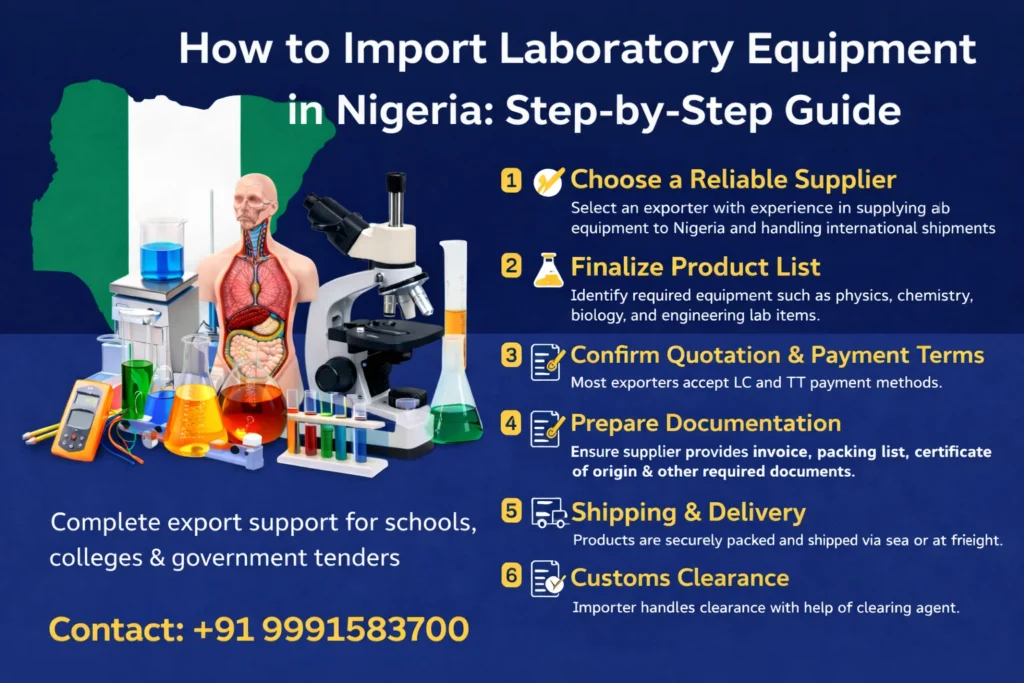
Step 1: Choose a Reliable International Supplier
The first and most important step is selecting a supplier with proven export experience, especially in African markets. A reliable exporter understands Nigeria’s import procedures and provides complete support for documentation, packaging, and delivery.
Working with an experienced supplier ensures:
- Compliance with international standards
- Proper export documentation
- Smooth handling of bulk and tender-based orders
Step 2: Finalize the Product List
Next, institutions must clearly define their equipment requirements based on curriculum and project scope. Typically, this includes:
- Physics laboratory equipment
- Chemistry laboratory equipment
- Biology lab instruments
- Engineering and workshop equipment
- Technical and vocational training kits
Additionally, laboratory glassware such as beakers, flasks, burettes, and measuring cylinders should be included for science labs, as they are essential for accurate experiments and safe handling.
Step 3: Confirm Quotation and Payment Terms
Once the product list is finalized, the supplier provides a detailed quotation including pricing, packaging, and shipping details. Common international payment methods include:
- Letter of Credit (LC)
- Telegraphic Transfer (TT)
Clear agreement on payment terms helps avoid financial risks and ensures transparency in transactions.
Step 4: Prepare Export Documentation
Documentation is a critical part of the import process. The supplier must provide all necessary documents required for customs clearance in Nigeria, including:
- Commercial invoice
- Packing list
- Certificate of origin
- Bill of lading or airway bill
Accurate documentation ensures smooth customs processing and prevents delays.
Step 5: Shipping and Delivery
After documentation and payment confirmation, the supplier arranges shipment. Depending on order size and urgency, goods are shipped via:
- Sea freight (cost-effective for bulk orders)
- Air freight (faster for urgent deliveries)
Proper packaging is essential to ensure that sensitive laboratory equipment and glassware arrive safely without damage.
Step 6: Customs Clearance in Nigeria
Once the shipment arrives, the importer or institution must complete customs clearance with the help of a licensed clearing agent. This step includes:
- Submission of required documents
- Payment of applicable duties and taxes
- Inspection and release of goods
Working with an experienced clearing agent helps speed up the process and ensures compliance with Nigerian import regulations.
Why Professional Export Support Matters
Importing laboratory equipment can be complex, especially for large institutional or government projects. Therefore, working with a supplier that offers end-to-end support—including documentation, packaging, and logistics—ensures a smooth and hassle-free experience.
Frequently Asked Questions
What documents are required to import laboratory equipment in Nigeria?
The key documents include a commercial invoice, packing list, certificate of origin, and shipping documents such as bill of lading or airway bill.
How long does it take to import lab equipment in Nigeria?
Delivery time depends on the shipping method. Air freight is faster, while sea freight takes longer but is more cost-effective for bulk orders.
Can schools and institutions import directly?
Yes, schools, colleges, and government institutions can import directly by following proper procedures and working with experienced suppliers.
Contact for Export Supply to Nigeria
If you are planning to import laboratory equipment for schools, colleges, or government tenders in Nigeria, professional export support can simplify the entire process and ensure timely delivery.
📞 WhatsApp: +91 9991583700
For a complete and reliable sourcing experience, you can explore a wide range of laboratory and engineering products at https://www.aseducationalkits.com/products-showcase/, which covers equipment suitable for schools, colleges, and government projects. Additionally, for high-quality laboratory glassware essential for accurate scientific experiments, refer to https://www.iwaki-pyrex.com/products/. Institutions can also browse a comprehensive catalogue of lab solutions at https://interlabs.in/products-catalogue/ for broader product insights. Moreover, for activity-based learning and primary education, innovative kits are available at https://www.labscientificequipments.com/product-category/jaadui-pitara-kit/. To ensure compliance with international standards and tender requirements, it is recommended to review certifications here: https://www.aseducationalkits.com/engineering-laboratory-equipment-certifications/.